
 Studied Rest · Research-based sleep sounds
Calm sounds that have actually been studied.
Long, calm videos for winding down: crackling fireplaces, soft pink noise, and slow, quiet music. We choose sounds researchers have studied, put the sources in every description, and tell you what the research doesn't show.
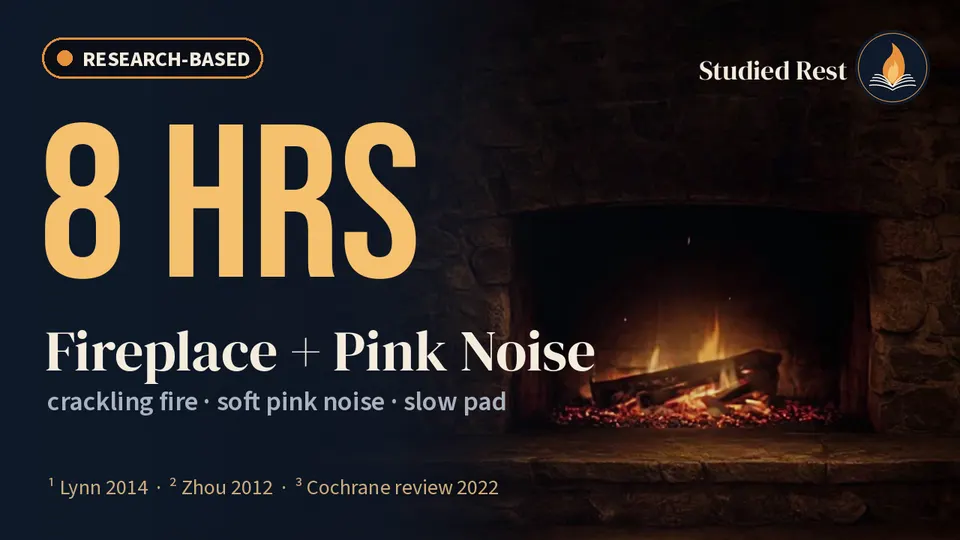
Cozy Stone Hearth | 8 Hours
A dim stone fireplace with slow, gentle flames, soft crackles, a low bed of pink noise, and a quiet 60 BPM ambient pad underneath. The screen stays dark. No talking and no sudden sounds.
The fireplace footage is AI-generated and looped; the audio is original and synthesized for Studied Rest. Tapping play loads YouTube, which may set its own cookies.
What you're hearing, and what the research says.
Every Studied Rest video lists numbered footnotes. Here's the short version of each, with links you can check yourself.
Crackling fire
In 226 adults, watching a fire video with sound was linked to lower blood pressure, more so with longer viewing. Muted fire didn't show the same effect. Honest note: this was a relaxation study in awake adults, not a sleep study.
Lynn CD. Evolutionary Psychology 2014;12(5):983-1003. PubMed ↗
Soft pink noise
In a small study (40 overnight participants), people sleeping with steady pink noise had more "stable sleep" than on quiet nights. Honest note: a 2022 systematic review found many pink-noise studies were positive but no strong evidence overall, and a 2021 review rated continuous noise as a sleep aid as very low quality evidence. We use pink noise as a gentle masking layer, not a treatment.
Zhou J, et al. J Theor Biol 2012;306:68-72. · Capezuti E, et al. J Clin Sleep Med 2022. · Riedy SM, et al. Sleep Med Rev 2021. PubMed 1 ↗ · PubMed 2 ↗ · PubMed 3 ↗
Slow, quiet music
A Cochrane review of 13 trials (1,007 adults) found moderate-certainty evidence that listening to music improved self-reported sleep quality. Those trials used their own music, not our videos.
Jespersen KV, et al. Cochrane Database Syst Rev 2022;8:CD010459. PubMed ↗
No miracle sounds.
- We don't claim any sound treats insomnia or any sleep disorder.
- We don't claim pink noise in a video boosts deep sleep or memory. The lab studies that showed this used brief sounds timed to brain waves by EEG, which no video can do. Ngo 2013 ↗ · Papalambros 2017 ↗
- We don't claim the fire effect is proven for sleep. It was measured in awake adults.
- No "healing frequencies," 528 Hz, Solfeggio, "DNA repair," or binaural-beat brainwave claims.
- No "fall asleep in X minutes" promises, and no sleep supplements.
Keep it low.
Play sleep sounds at a low, comfortable volume, especially for long listening. Around babies, keep any sound machine low and away from the crib: a study of infant sleep machines found some could exceed recommended noise limits at maximum volume. Hugh 2014 ↗
If you have ongoing trouble sleeping, loud snoring, or daytime sleepiness, please talk with a healthcare professional. For chronic insomnia, the American College of Physicians recommends cognitive behavioral therapy for insomnia (CBT-I) as the first treatment for adults. ACP 2016 ↗
See sleep gear with evidence notes →Studied Rest is for relaxation and general information only. It is not medical advice. See our medical disclaimer.